September 7, 2026
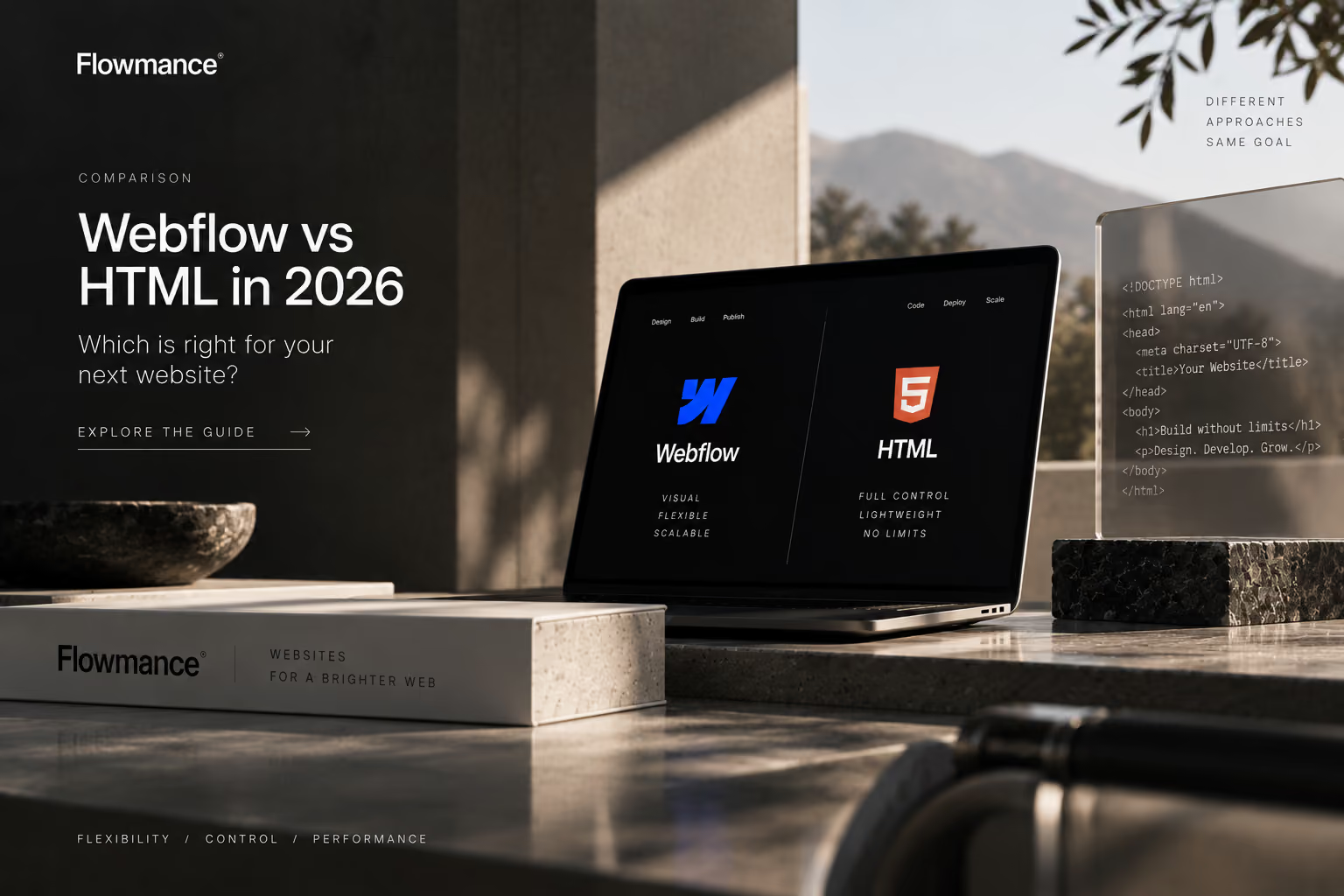
Choose Webflow when a marketing, design or content team needs to build and maintain a professional website visually. Choose an HTML-based workflow when direct source-code ownership, hosting freedom and developer-level control matter more than visual editing.
The important distinction is that Webflow and HTML are not exact substitutes. HTML is the markup language that structures web content; Webflow is a visual website platform that generates web output while also providing hosting, CMS, interactions and site-management tools. The practical decision is therefore usually Webflow versus a code-first HTML/CSS/JavaScript workflow.
| Factor | Webflow | HTML workflow |
|---|---|---|
| Editing | Visual Designer plus code options | Direct editing in source files or a development environment |
| Code ownership | Exportable HTML, CSS, JavaScript and assets on eligible Workspace plans, with limitations | Project source files are directly controlled by the development team |
| CMS | Native visual CMS workflows | Requires a CMS, static-site generator, backend or manual files when dynamic content is needed |
| Hosting | Integrated Webflow hosting, or export eligible static code | Choose the host, CDN and deployment stack |
| Maintenance | Friendly for designers and content teams | Usually requires more technical ownership |
| Custom development | Strong visual foundation with custom-code extensions | Maximum implementation freedom |
HTML is the basic building block of the web and defines the meaning and structure of page content. CSS handles presentation and JavaScript commonly adds behavior. In practice, an “HTML website” usually means a code-first site where the team works directly with those front-end files rather than managing the site primarily through a hosted visual builder.
Static HTML is particularly efficient for smaller sites that return the same prepared content to every visitor. As MDN explains, static sites become less convenient as the number of pages grows because repeated structures and content can become expensive to maintain. That is where a CMS, templating system or other dynamic layer often becomes useful.
Webflow's biggest advantage is that layout, typography, responsive behavior and many interactions can be built visually while retaining web concepts such as classes, flexbox, grid and semantic elements. A designer can make production changes without opening a traditional code editor for every adjustment.
That is valuable for agencies, marketing teams and companies whose websites evolve continuously. A new service page, case study or campaign should not necessarily require a developer deployment every time the content or layout changes.
With a code-first HTML workflow, the editing experience depends on the stack the developer creates. It can be extremely efficient, but the source files themselves do not provide a visual content-management experience.
If owning and controlling the front-end source is a primary requirement, an HTML workflow is the simpler model. The files can live in your repository, move between hosting providers and integrate into whatever development process the project requires.
Webflow also supports code export on paid Workspace plans. According to Webflow's current documentation, an export includes the site's HTML pages, CSS, JavaScript and uploaded assets. Exported code can be hosted elsewhere and does not require Webflow attribution.
However, this is not equivalent to exporting the entire Webflow platform. Webflow states that CMS databases and functionality, Ecommerce, User Accounts, site search, form processing, localized content and some other platform features are not included as working functionality in the static code export. If those systems are central to the project, moving away from Webflow hosting requires replacement infrastructure.
A static site is excellent when there are relatively few pages and the content does not change often. For hundreds of articles, projects, products or locations, manually maintaining repeated HTML files becomes inefficient. Dynamic systems solve this by storing content separately and using templates to render many pages consistently.
Webflow packages that model into a visual CMS. Teams can create structured collections for articles, projects, team members, services and other repeatable content, then connect those fields to reusable layouts.
A code-first team can build an equally powerful or more sophisticated content architecture, but HTML alone does not provide it. You need to choose and maintain the additional CMS, database, generator or application framework.
Webflow combines the build environment and hosting workflow. For teams that want fewer infrastructure decisions, that is an advantage: design, CMS changes and publishing live in one system.
An HTML template separates the front end from the hosting provider. The files can be deployed to the infrastructure your team prefers and integrated with APIs, backend services, analytics or a custom deployment pipeline. That flexibility is one reason developers choose code-first projects.
Flowmance reflects both workflows: its Webflow template library is aimed at visual Webflow production, while the HTML template library provides downloadable front-end source files for teams that prefer direct code control.
Search engines ultimately evaluate the website that is delivered, not whether the team edited it in a visual builder or a code editor. Both approaches can support semantic headings, metadata, image alt text, canonical URLs, structured data, fast assets and crawlable internal links.
Webflow makes many SEO tasks accessible to non-developers and can connect metadata to CMS fields. A custom HTML workflow gives developers complete control over markup and deployment, but the team must implement and maintain the SEO system itself.
For SEO, choose based on operational discipline: who will maintain titles, redirects, structured content, internal links and technical quality after launch?
A small static HTML site can be extremely lightweight because it may need little server-side processing. But “HTML” does not automatically mean fast: oversized media, third-party scripts and poorly written JavaScript can make any site slow.
Webflow can also deliver fast production sites when media, interactions and third-party scripts are handled carefully. In both workflows, performance depends on the actual page weight, asset strategy, interaction complexity and hosting setup rather than the builder name alone.
Code-first HTML can have a low infrastructure footprint, but developer time is part of the real maintenance cost. If every text, page or layout change requires a technical handoff, a visually managed platform may be cheaper operationally even when its hosting costs more.
Conversely, a development team that already uses Git, automated deployment and a preferred front-end stack may find a visual platform unnecessary. For that team, source files can be the more maintainable system.
Agencies should choose Webflow when clients need visual editing, CMS access and a straightforward handoff after launch. It is particularly useful when the agency wants a repeatable production workflow without building a custom editing layer for each client.
Choose HTML when the client has a development team, requires a specific hosting environment, needs deeper application integration, or explicitly wants the front-end source integrated into an existing codebase.
Starting from a template can accelerate either route. Flowmance maintains both Webflow and HTML formats, while Flowmance+ is intended for teams that build repeatedly across the library.
Yes, with important limitations. Webflow currently allows eligible Workspace users to export HTML, CSS, JavaScript and assets. The exported front end can be edited and hosted independently, but Webflow-hosted functionality such as CMS behavior, Ecommerce, User Accounts, form processing and site search does not transfer as a working static system. Those features need alternatives if the exported site leaves Webflow.
This distinction is worth understanding before choosing a platform based on “exportability.” Exporting a rendered front end is not the same as exporting an entire hosted CMS and application environment.
Webflow is the better choice for teams that want a visual, integrated website system. HTML is the better choice for teams that want direct source-code control and infrastructure freedom.
For most marketing sites, the decision should be based on who will operate the website after launch. If designers, marketers and editors need to work independently, Webflow removes substantial friction. If developers own the full stack and portability is a core requirement, a code-first HTML workflow is difficult to beat.
Compare current starting points in Flowmance's Webflow templates and HTML templates before deciding which production model fits the project.









Don’t miss out on our superb, customizable templates designed to enhance your web design experience. We constantly add new templates and components.

Explore stunning Webflow, Framer, and Figma templates designed to spark your next big idea.


*Rest assured that your data is safe with us, and you'll only hear from us 1 time per month.