Webflow vs Framer SEO and AEO in 2026: current native SEO controls, CMS scale, JSON-LD, AI visibility, Google AI guidance, localization and which platform fits each growth model.
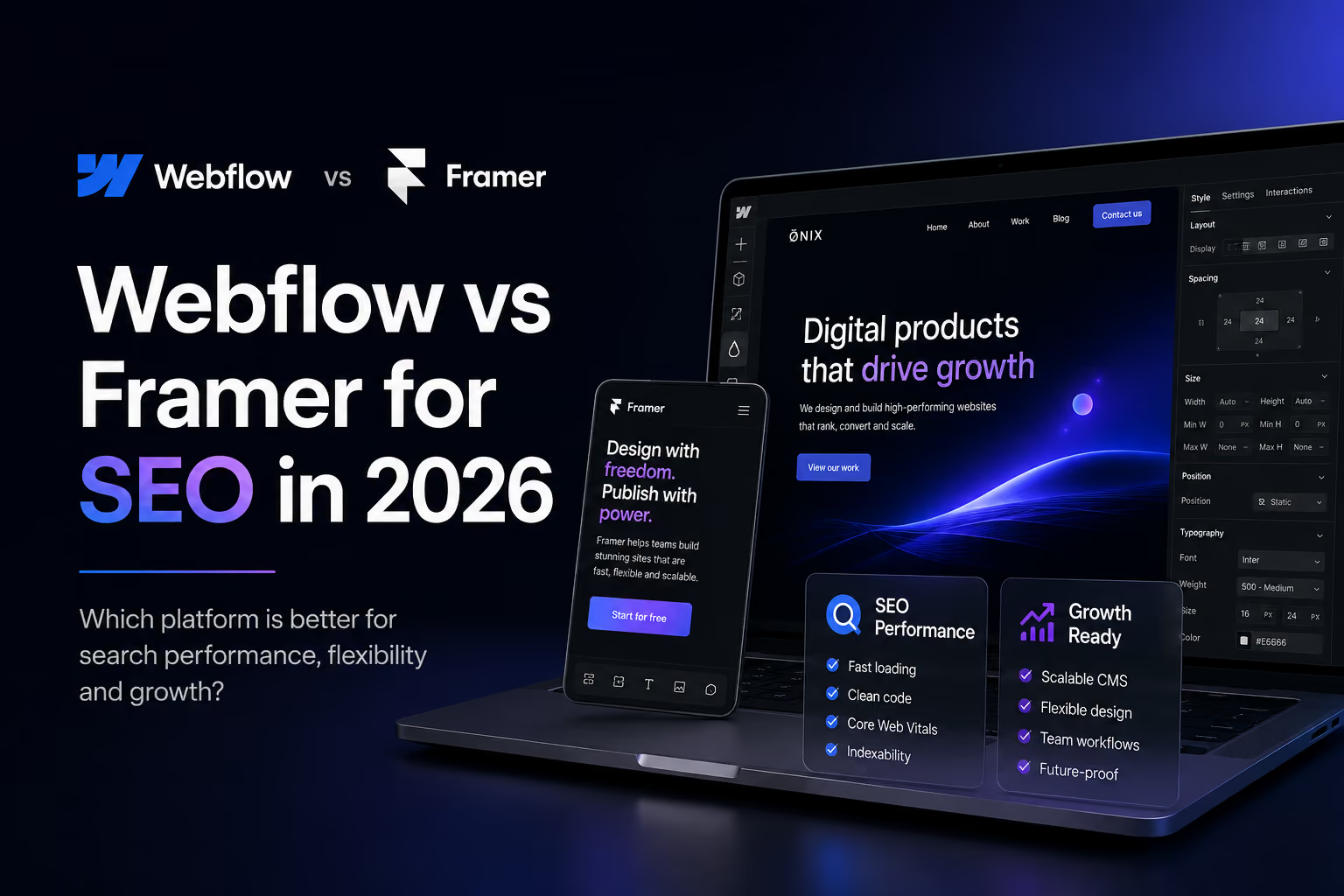
Short answer: both Webflow and Framer can rank well and support AI-search visibility in 2026. Webflow is the stronger default for large, content-led SEO/AEO programs that need deeper CMS capacity, native schema workflows, migrations, localization and search/AI visibility tooling. Framer is an excellent choice for design-led marketing sites where speed of publishing, strong technical fundamentals and a simpler workflow matter more than advanced SEO operations.
The builder itself does not create rankings or AI citations. Search intent, original evidence, clear entity information, crawlability, internal links, authority and performance matter more. The useful question is which platform makes those fundamentals easier for your team to maintain as the site grows.
| Area | Webflow | Framer |
|---|---|---|
| Titles, descriptions & canonicals | Native, including CMS-driven fields | Native, including CMS variables |
| Schema / structured data | Dedicated page-level schema workflow with AI assistance | JSON-LD through Custom Code, including CMS variables |
| CMS scale | Premium includes 20,000 items and 40 Collections | Basic: 1,000 items/2 Collections; Pro: 2,500/10, expandable |
| Redirects | Mature native workflow | Native redirects; Pro includes site redirects |
| Localization | Granular localized SEO and hreflang workflows | Native localization and language signals |
| AEO / AI visibility | Native SEO/AEO auditing plus Analyze visibility into LLM and AI-agent traffic | Strong crawlable-content fundamentals and support for fixed-path files such as llms.txt |
| Best fit | Large content programs, migrations, relational CMS and SEO operations | Portfolios, startups and fast-moving design-led marketing sites |
Product capabilities and pricing checked September 15, 2026. Platform features and plan requirements can change.
The most important shift is not a new meta-tag feature. Website teams increasingly need to understand discovery from both search engines and AI systems.
Webflow now explicitly includes SEO & AEO in its AI tooling. Its current pricing documentation says Webflow AI can run sitewide audits and provide suggestions for search and answer-engine visibility. Webflow Analyze also includes AEO-oriented insights such as LLM visibility and AI-agent traffic. This gives teams a native feedback loop between publishing and AI discovery rather than treating AEO as an abstract checklist.
Source: Webflow pricing and current feature matrix.
Framer takes a lighter approach. Its SEO foundation remains strong for focused marketing sites, and its current SEO tooling supports fixed-path files such as robots.txt and llms.txt. An llms.txt file should be treated as an additional machine-readable surface, not as a shortcut to citations. Useful, accessible pages and trustworthy evidence still do the real work.
Source: Framer SEO.
Webflow provides native controls for titles, meta descriptions, canonical URLs, image alt text, indexing, XML sitemaps and 301 redirects. Its generated sitemap updates on publish and can include modification timestamps. Webflow also gives site owners page-level indexing controls, which is valuable on established sites where thin utility pages, migration remnants and duplicate routes need deliberate handling.
Framer covers the technical fundamentals required by most modern marketing sites: editable metadata, CMS-driven SEO values, redirects, localization, performance tooling and site files. The difference is therefore not “SEO versus no SEO.” It is operational depth. Webflow is usually easier to standardize across a large SEO program; Framer is often faster for a smaller team shipping a focused site.
Webflow changed its Site plans in 2026. The new Premium plan is $25/month billed yearly and includes 20,000 CMS items and 40 CMS Collections. That is a significant change from older comparisons that still quote the former CMS plan limits.
Framer currently lists Basic at $10/month billed yearly with 1,000 CMS items and 2 Collections, while Pro is $30/month with 2,500 items and 10 Collections. Framer also offers paid scaling beyond those included limits.
Sources: Webflow pricing and Framer pricing. For a deeper content-system analysis, read our Webflow CMS vs Framer CMS comparison.
Capacity is not ranking power by itself. It matters because larger editorial programs need predictable content models, reusable metadata, topic relationships and internal links that remain manageable after hundreds or thousands of pages.
AEO is not a separate trick that replaces SEO. Pages that are easy for search engines and AI systems to interpret usually have clear entities, direct answers, descriptive headings, useful evidence, consistent internal links and machine-readable data where relevant.
Webflow has a dedicated schema-markup workflow and can use Webflow AI to help generate schema. For Collection pages, CMS fields can be incorporated into repeatable structured-data patterns. See Webflow's schema and AEO documentation.
Framer also supports structured data through JSON-LD in Custom Code. Its current documentation shows that CMS variables can be used to generate unique schema for CMS detail pages, including fields such as title, excerpt, cover image and publication dates. See Framer's structured-data documentation.
The practical requirement is the same on either platform: publish information worth citing. Original measurements, transparent comparisons, first-party examples and clearly dated claims are more defensible than generic summaries.
Redirect management becomes critical when a redesign changes established URLs. Webflow has a mature native 301 workflow and is particularly comfortable for migrations where preserving organic equity is central. Framer has expanded its redirect and hosting capabilities and is increasingly viable for established marketing sites.
For either platform, export the old URL inventory first, map every valuable URL to its closest replacement, preserve strong slugs whenever possible, test redirects after launch and avoid sending unrelated retired pages to the homepage.
Webflow Localize supports localized slugs, SEO titles, descriptions, Open Graph data and locale-aware sitemap signals. Framer also manages language and hreflang signals for localized sites. For a compact multilingual marketing site, either can work well. Webflow becomes more attractive when localization is part of a larger CMS and governance system.
Both platforms can produce fast websites. Neither guarantees strong performance if pages are overloaded with autoplay video, oversized images, third-party scripts or unnecessary animation. Optimize the actual production pages rather than choosing a builder from generic speed claims.
Google's 2026 guidance is useful because it separates durable optimization from AEO myths. Google says its established SEO best practices remain relevant for generative AI features in Search, while emphasizing useful, non-commodity content and strong supporting media and evidence. In other words, there is no separate technical shortcut that replaces making a page genuinely useful.
Google also clarified in June 2026 that llms.txt is not needed for Google Search and does not positively or negatively affect Google visibility or rankings. Framer's ability to publish an llms.txt file can still be useful for other systems that choose to consume it, but it should not be presented as a Google ranking advantage.
Another important 2026 change: Google stopped showing FAQ rich results in Search. FAQs can still improve a page when they answer real follow-up questions, but adding FAQ sections or FAQ schema solely to chase a Google rich result is no longer a sound strategy.
Sources: Google Search documentation updates and Google Search appearance documentation.
| Project | Better starting point | Why |
|---|---|---|
| Design portfolio | Framer | Fast visual iteration and simpler publishing |
| Startup marketing site | Framer | Rapid landing-page and positioning changes |
| Large editorial/resource hub | Webflow | Higher included CMS scale and deeper content operations |
| SEO-led agency site | Either | Depends on content depth and operating model |
| Large migration | Webflow | Mature redirect and site-management workflows |
| Relational directory/content system | Webflow | Stronger fit for structured, connected CMS architecture |
Choose Webflow when organic and AI discovery are central growth channels for a large, evolving website and your team needs deeper native CMS, schema, migration, localization and visibility tooling.
Choose Framer when the priority is a polished marketing site that a design team can launch and iterate rapidly. For portfolios, agencies and focused startup sites, its simpler workflow can be a genuine advantage.
The strongest decision is not “which builder ranks better?” It is “which builder matches the scale and operating model of the search and content program we need to run?”
Compare production-ready structures across Webflow templates, Framer templates, Figma templates and HTML templates. For access across the broader library, see Flowmance+.









Don’t miss out on our superb, customizable templates designed to enhance your web design experience. We constantly add new templates and components.

Explore stunning Webflow, Framer, HTML5, Next.js and Figma templates designed to spark your next big idea.


*Rest assured that your data is safe with us, and you'll only hear from us 1 time per month.